

At the end of June the Health and Safety at Work (Hazardous Substances) Amendment Regulations 2026 were passed, and came into effect on 30 July 2026.
In this article, Janet Connochie our Senior Hazardous Substances Consultant, Compliance Certifier and Director covers the changes relating to hazardous areas. In relation to flammable gas and liquids, a hazardous area is a defined area in which an explosive or flammable atmosphere could be present, and therefore ignition sources need to be excluded or controlled.
The amendment updates Regulation 10.6(1) and updates the standard referenced from the 2009 edition to the 2022 edition.
Previous
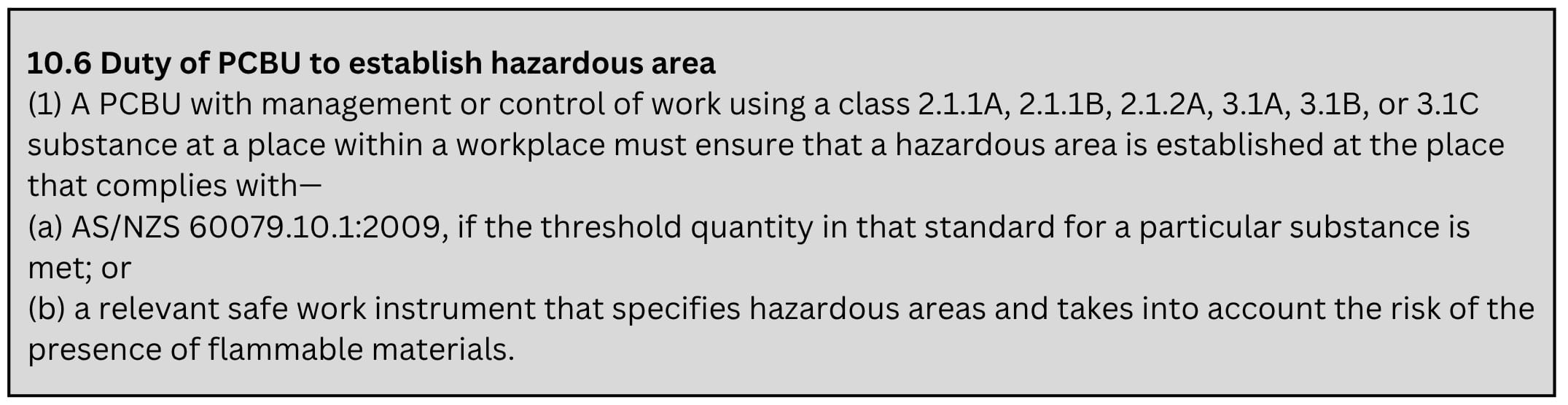
From 30 July 2026

There is a transition period, so that if you have established or will be establishing a hazardous area, you can continue to apply the 2009 standard for a period of up to 3 years (to 30 July 2029).
What are the standards?
The standards provide methodologies for estimating the hazardous area based on various principles – including sources of release and available ventilation/dilution. This is a complex field.
In addition, there are presented a range of example classifications that may apply to common examples – these are Annex ZA in the 2009 standard and the Appendices of the Supplement to the 2022 standard. Caution is needed when applying these to ensure that the situation at hand is correctly represented by the examples. The 2022 standard groups these examples into three categories;
- Commonly accepted industry classifications – can generally be used – make sure your situation doesn’t differ significantly from the direct example
- Common application examples – may be suitable for common examples – make sure your situation doesn’t differ significantly from the direct example
- Illustrative examples – use with caution, they provide conservative guidance, but might be unsuitable for some situations.
Did we mention this can be a complex field?
What do the regulations require?
The regulations require that the PCBU
- Establish a hazardous area
- Any electrical appliances or installations comply with the Electricity Act and Electricity (Safety) Regulations
- Reduce the likelihood of unintended ignition by means of
- Controlling ignition sources – including provisions for substances where a hazardous area may not have been established
- Controlling both the proportion of flammable vapour or flammable gas to air and the amount of energy available
- Controlling the proportion of vapour or gas to air (but not the level of energy)
- Addition control is required where oxygen is present below or above normal ambient concentrations